
Postoperative Deterioration & Complications
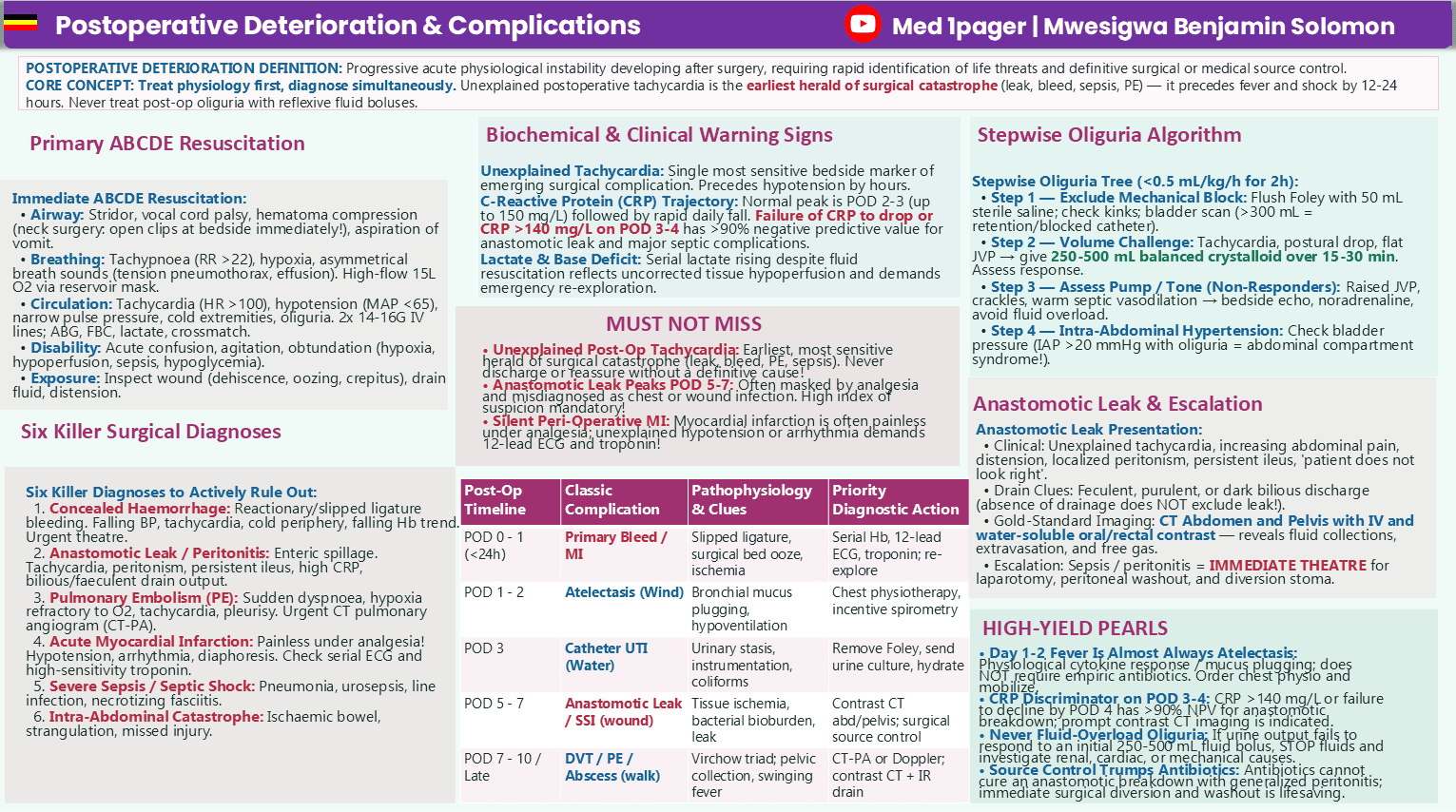
Postoperative deterioration demands simultaneous Airway, Breathing, Circulation, Disability, and Exposure physiological resuscitation and targeted...
Pinch or double-tap to zoom. Drag to pan when zoomed in. Keyboard: + / − to zoom, arrow keys to pan, 0 to fit.
Free to download for personal study. You can also save the image directly.
Read topic overview
Postoperative deterioration demands simultaneous Airway, Breathing, Circulation, Disability, and Exposure physiological resuscitation and targeted investigation to rule out the six life-threatening surgical emergencies: concealed hemorrhage, anastomotic leak, pulmonary embolism, silent myocardial infarction, severe sepsis, and intra-abdominal catastrophe. Unexplained tachycardia is the earliest and most sensitive bedside warning sign of surgical catastrophe, often preceding fever or hypotension by 12 to 24 hours. Clinicians must master the postoperative fever timeline, C-reactive protein trajectories, and the stepwise algorithm for oliguria to intervene early and avoid reflexive fluid overload.
Clinical Self-Assessment
Test your understanding
Select an answer on any question to immediately see if you are right and read the clinical explanation.
Showing 5 of 20 questions (0 answered).