
Peritonitis & viscus perforation
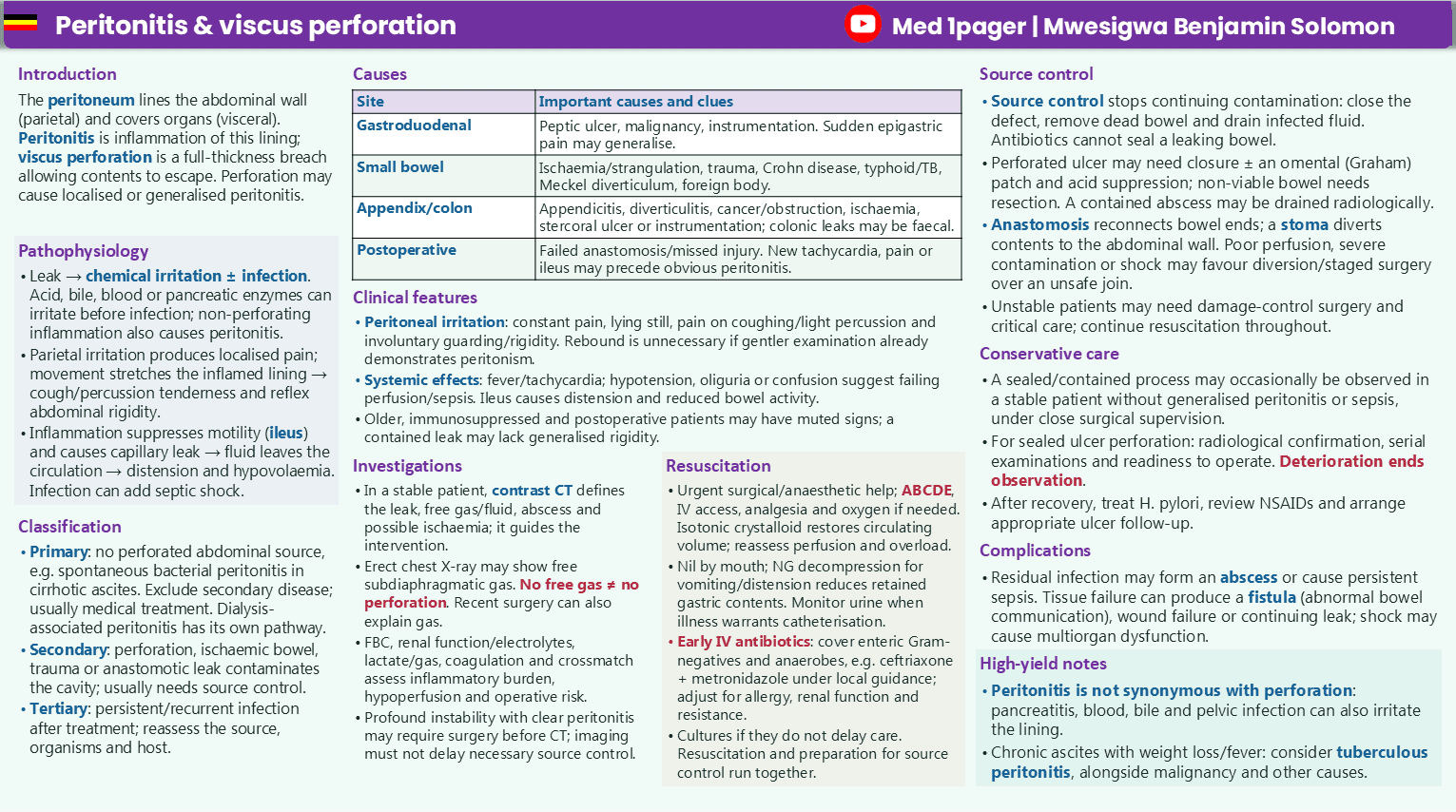
Peritonitis is inflammation of the peritoneal lining, most commonly triggered in surgical practice by hollow viscus perforation, bowel ischaemia, or...
Pinch or double-tap to zoom. Drag to pan when zoomed in. Keyboard: + / − to zoom, arrow keys to pan, 0 to fit.
Free to download for personal study. You can also save the image directly.
Read topic overview
Peritonitis is inflammation of the peritoneal lining, most commonly triggered in surgical practice by hollow viscus perforation, bowel ischaemia, or anastomotic leakage that releases chemical irritants and enteric microbes into the peritoneal cavity. The resulting cascade of parietal somatic pain, paralytic ileus, massive third-space capillary leak, and sepsis rapidly progresses to multiorgan failure without prompt fluid resuscitation, broad-spectrum antibiotics, and definitive surgical source control. Understanding the classification of peritonitis, site-specific perforation clues, diagnostic imaging pitfalls, and principles of operative versus damage-control management is foundational for surgical care.
Clinical Self-Assessment
Test your understanding
Select an answer on any question to immediately see if you are right and read the clinical explanation.
Showing 5 of 20 questions (0 answered).