
Neurology

myasthenia gravis

this is a guide to myasthenia gravis

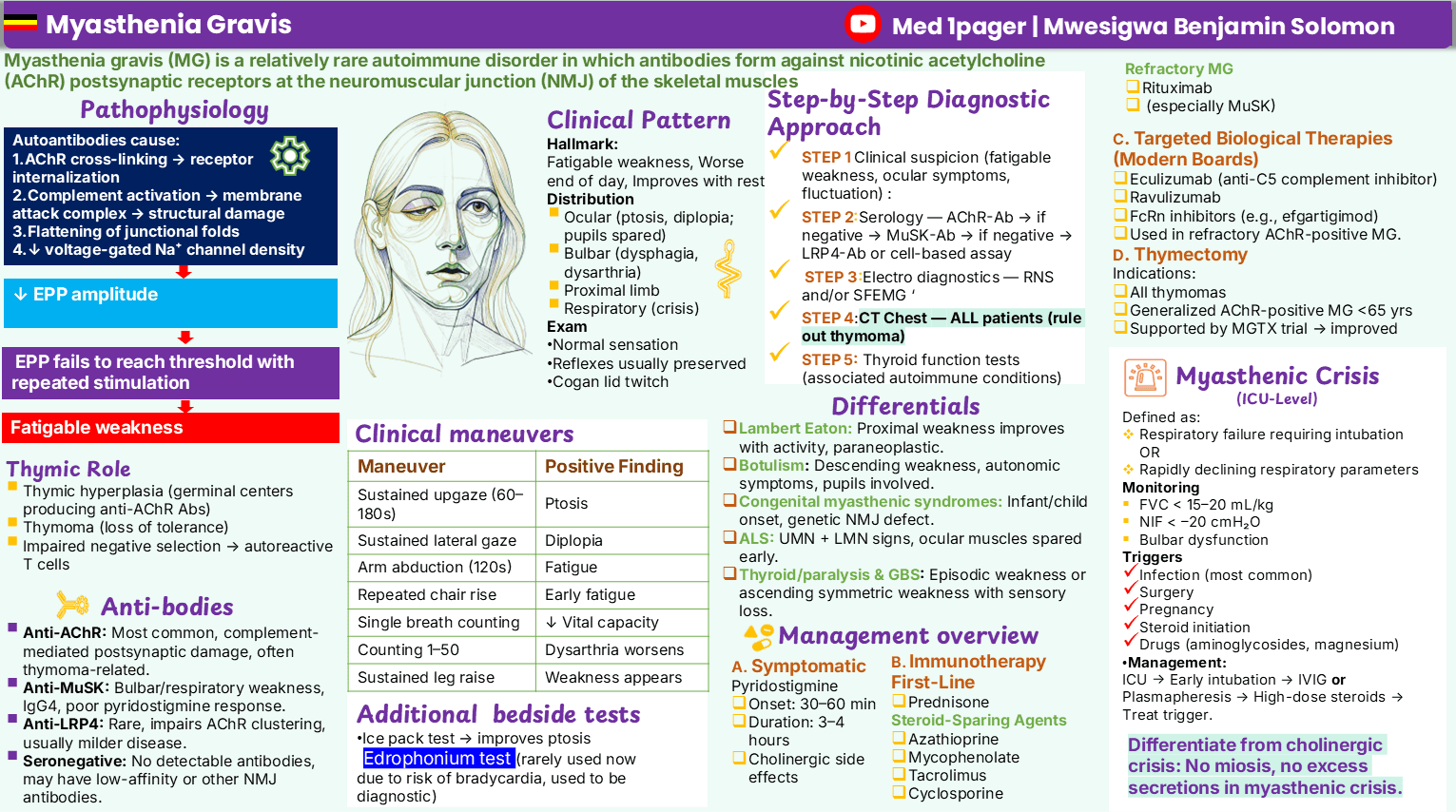
Myasthenia gravis is an autoimmune disorder in which antibodies target acetylcholine receptors at the neuromuscular junction, leading to characteristic fatigable weakness that worsens with repeated muscle use and improves with rest. The condition carries significant clinical importance because it can progress to life-threatening myasthenic crisis requiring ICU-level care, and its diagnosis involves a stepwise approach including serological testing for specific antibodies and evaluation for thymoma, which is present in a subset of patients. Medical students must recognize the hallmark pattern of ocular, bulbar, and proximal limb weakness, understand the critical distinction between myasthenic and cholinergic crises, and appreciate that treatment spans from symptomatic management with pyridostigmine to immunotherapy and thymectomy in appropriate candidates.

Free forever

The summary, the quiz, and the download stay accessible without forcing a sign-in flow. Donations only support the mission.
Watch on YouTube
myasthenia gravis one-page medical summary

Right-click or long-press to save the image directly.

Quiz mode

Test your knowledge

Answer the visible questions first, then score yourself before revealing more.

1. What is the primary target of autoantibodies in myasthenia gravis?

2. Which antibody type is most commonly found in myasthenia gravis and is often thymoma-related?

3. What is the hallmark clinical feature of myasthenia gravis?

4. What diagnostic test should be performed in ALL patients with suspected myasthenia gravis to rule out thymoma?

5. Which pathophysiological mechanism leads to decreased EPP amplitude in myasthenia gravis?

Answer all 5 visible questions to submit.

Subscribe free